10 Best Dog Training Treats That Turn Distracted Dogs Into Focused Learners (Trainer-Tested Picks)
When you purchase through links on our site, we may earn an affiliate commission at no extra cost to you. We only recommend products we’ve personally tested, thoroughly researched, or believe will genuinely help you and your dog. Here’s how it works.

I spent months thinking my dog, Biscuit, was just stubborn. I tried repeating commands louder. I tried being more stern. Nothing worked.
Then a dog trainer told me something that changed everything: “You don’t have a training problem. You have a reward problem.”
She was right. The treats I was using were boring.
My dog just didn’t care enough to listen. The second I switched to the right treats, she started nailing commands in minutes.
The best dog training treats are small, soft, aromatic, and low in calories. That combo keeps dogs focused, fast, and food-motivated through every rep.
In this article, you’ll get the top 10 trainer-approved treats, a clear explanation of why they work, and a simple system for matching the right treat to the right training moment.
I’ve also included a comparison table, tips for avoiding the most common treat mistakes, and answers to the most common questions dog owners ask.
Whether you have a new puppy, a rescue dog with a short attention span, or a stubborn senior who ignores you at the dog park, the right treat can flip the switch.
Let’s find yours.
What Makes a Great Dog Training Treat?
One thing most dog owners don’t know is that professional trainers don’t just grab any bag of treats off the shelf.
They think about treats the same way a coach thinks about equipment. The wrong tool slows you down. The right one speeds everything up.
I learned this the hard way after buying a giant bag of crunchy biscuits for my dog’s first training class.
The trainer took one look and said, “Those are great for snacks. Not for training.” Here’s what she taught me to look for instead.
Small Size Means Faster Learning
Think pea-sized. Seriously, that small.
When treats are tiny, your dog can eat them in one second and look right back at you. That fast cycle is everything in training. The more reps you get in a session, the faster your dog learns.
Big treats do the opposite. Your dog chews, sniffs the floor for crumbs, loses focus, and the whole session slows to a crawl. Some dogs even get full after 10 treats and stop caring altogether.
A good rule to follow: if the treat is bigger than your pinky nail, break it in half.
Many trainers give dozens of rewards in a typical session, often far more than in casual pet training. You want your dog hungry and happy the whole time, not stuffed after the first five minutes.
Why Soft Treats Beat Crunchy Treats
Crunchy treats crunch. That sounds obvious, but it matters because chewing takes time, and time kills momentum.
Soft treats are usually eaten very quickly, which helps keep training momentum. Your dog’s brain links the behavior to the reward almost instantly. That speed is what locks in learning.
The shorter the gap between “good behavior” and “reward,” the faster your dog understands what they did right.
Soft treats also work better for older dogs or dogs with sensitive teeth. And they’re much easier to break into tiny pieces on the fly during a walk or class.
The Secret Power of Strong-Smelling Treats
Dogs experience the world through their nose first. A treat that smells amazing to a dog is like dangling your favorite food in front of you when you’re starving. It’s hard to ignore.
This matters most when you’re training in busy or distracting places, such as parks, sidewalks, or pet stores.
A plain dry biscuit smells like cardboard next to a squirrel, another dog, or a dropped sandwich. But a piece of freeze-dried liver? That cuts through almost any distraction.
Trainers use strong-smelling treats specifically for recall training (teaching your dog to come when called), leash reactivity work, and any skill that needs to compete with the outside world.
Why Calories Matter During Training
Most vets agree that treats should make up no more than 10% of your dog’s daily calorie intake. Ensure you remember this.
A 20-pound dog might only need around 400 to 500 calories per day. If each treat is 10 to 15 calories, and you’re giving 30 to 50 during a training session, those calories add up fast. Do that daily, and your dog can gain weight without you noticing why.
Low-calorie treats (under 5 calories each) let you train longer, reward more often, and not worry about your dog’s waistline.
That’s why experienced trainers and veterinarians recommend checking the calorie information on treat labels before heavy training.
The best training treat hits all four marks. They’re small, soft, smelly, and low in calories.
Keep those four words in your head as we go through the top 10 picks, and you’ll know exactly what to look for and why each one made the list.
Quick Comparison Table: The Best Dog Training Treats at a Glance
Before we dig into each treat, here’s a fast overview so you can scan and spot the right fit for your dog right away.
| # | Treat | Best For | Calories Per Treat | Texture | Price Range | Rating |
| 1 | Zuke’s Mini Naturals | Overall best | 3.5 cal | Soft | $11.88 – $14.94 | ⭐⭐⭐⭐⭐ |
| 2 | Pupford Freeze-Dried | Low-calorie training | 1–2 cal | Soft/dry | $16.85 | ⭐⭐⭐⭐⭐ |
| 3 | Pet Botanics Training Rewards | Budget pick | 3 cal | Soft | $10.55 – $16.64 | ⭐⭐⭐⭐ |
| 4 | Wellness Soft Puppy Bites | Puppies | 3 cal | Very soft | $4.99 – $9.98 | ⭐⭐⭐⭐⭐ |
| 5 | Stewart Pro-Treat Freeze-Dried Liver | High-value/tough behaviors | 2–3 cal | Dry | $10.99 – $12 | ⭐⭐⭐⭐⭐ |
| 6 | Blue Buffalo Blue Bits | Sensitive stomachs | 3 cal | Soft | $9–$13 | ⭐⭐⭐⭐ |
| 7 | PureBites Freeze-Dried Chicken | Allergy-prone dogs | 2 cal | Dry | $7–$12 | ⭐⭐⭐⭐⭐ |
| 8 | Bil-Jac Little-Jacs | Frequent training | 3 cal | Very soft | $7–$10 | ⭐⭐⭐⭐ |
| 9 | Fruitables Skinny Minis | Weight management | 3 cal | Soft | $6–$9 | ⭐⭐⭐⭐ |
| 10 | Stella & Chewy’s Carnivore Crunch | Premium choice | 2–3 cal | Crunchy/dry | $12–$18 | ⭐⭐⭐⭐⭐ |
How to use this table: Pick one everyday treat from the 3-calorie range for regular practice at home. Then pick one high-value treat (liver or freeze-dried meat) for tough situations, like a recall or leash training outdoors.
Having two tiers ready before your next session is one of the fastest ways to level up your results.
Prices are approximate and may vary by retailer and bag size. Always check current listings before buying.
Now let’s look at each treat up close so you know exactly what you’re getting, who it works best for, and where it might fall short.
Top 10 Best Treats for Dog Training
Not every treat on this list will be the right fit for your dog. Some dogs go crazy for liver. Others turn their nose up at it and beg for chicken. That’s normal.
The goal here is to give you enough detail on each one so you can pick with confidence, not just guess.
Each review covers: ingredients, calories, training benefits, who it’s best for, and one honest drawback.
#1. Best Overall: Zuke’s Mini Naturals Dog Training Treats

If you could only buy one training treat, this would be it.
Zuke’s Mini Naturals are soft, tiny (about the size of a pea), and low in calories at just 3.5 calories each.
They come in flavors like chicken, salmon, duck, and rabbit, so if your dog gets bored with one, you can switch it up without changing brands.
The ingredients are clean. The first ingredient is meat, and there are no corn, wheat, or soy fillers. For a treat you’ll be giving 30 to 50 times per session, that matters a lot.
Best for: All dogs, all training levels, indoor and outdoor use.
Drawback: Some dogs find them only mildly exciting. If your dog is easily distracted outside, you may need to pair these with a higher-value treat for outdoor sessions.
Price: Around $11.88 to $14.94 for a 6-ounce bag.
#2. Best Low-Calorie Option: Pupford Freeze-Dried Training Treats

At just 1 to 2 calories per treat, Pupford treats let you reward your dog constantly without worrying about overfeeding. That makes them a favorite for long training sessions or owners who train multiple times a day.
They come in flavors like salmon, sweet potato, and beef liver. The freeze-drying process locks in food smell, so they’re more exciting to dogs than their tiny size suggests.
Best for: Dogs on calorie-restricted diets, puppies in active learning phases, and owners who train daily.
Drawback: The texture is slightly drier than some dogs prefer. A few picky eaters ignore them completely.
Price: Around $16.85 for a 4-ounce bag.
#3. Best Budget Pick: Pet Botanics Training Rewards

You get a lot of treats for a little money here. Pet Botanics Training Rewards come in bags of 500 tiny soft treats, making them one of the most affordable options on this list.
They’re made with pork liver as the first ingredient, which gives them a scent dogs respond to. At 3 calories each and with a soft texture, they check most of the key boxes.
Best for: Budget-conscious owners, multi-dog households, and early obedience training.
Drawback: The ingredient list isn’t as clean as some premium options. If your dog has food sensitivities, check the label carefully first.
Price: Around $10.55 to $16.64 for a large bag.
#4. Best for Puppies: Wellness Soft Puppy Bites Dog Training Treats

Puppies have tiny mouths, developing stomachs, and short attention spans. Wellness Soft Puppy Bites were made with all three in mind.
These treats are extra soft, easy to break into even smaller pieces, and made with puppy-friendly ingredients like turkey and salmon. They’re gentle on young digestive systems and small enough to use freely without worrying about calories piling up fast.
Best for: Puppies 8 weeks and up, small breeds, and dogs with dental sensitivities.
Drawback: Not exciting enough for adult dogs with high distraction levels.
Price: Around $4.99 to $9.98 for a 3-ounce bag.
#5. Best High-Value Treat: Stewart Pro-Treat Freeze-Dried Liver Dog Treats
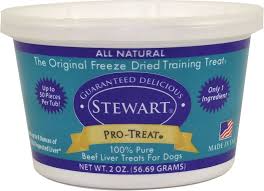
Liver is the gold standard of high-value dog treats. Professional trainers have used it for decades because most dogs will do almost anything for it.
Stewart Pro-Treat uses 100% beef liver, freeze-dried to lock in that powerful smell.
There’s one ingredient on the label. That’s it. No fillers, no additives, no guessing. Each piece is about 2 to 3 calories, and you can break them into even smaller bits.
Use these for your toughest training challenges, such as recall in a busy park, walking past other dogs without reacting, or any new skill your dog is struggling to learn.
Best for: Reactive dogs, recall training, distraction-heavy environments, and any behavior that needs an extra motivational push.
Drawback: The smell is strong, really strong. Keep the bag sealed tightly, or your whole bag will smell like liver within a day.
Price: Around $10.99 to $12, depending on size.
#6. Best for Sensitive Stomachs: Blue Buffalo Blue Bits
Some dogs get an upset stomach from rich or heavily processed treats. If your dog has ever had loose stools after a training session, the treats might be the reason.
Blue Buffalo Blue Bits are made with meat and wholesome ingredients, and they skip the artificial preservatives, colors, and flavors that can trigger digestive issues. They’re soft, low in calories, and come in flavors like chicken, beef, and turkey.
Best for: Dogs with sensitive stomachs, dogs on limited-ingredient diets, and owners who prefer natural ingredient lists.
Drawback: Slightly larger than some competing training treats. Break them in half for the best results.
Price: Around $9 to $13 for a 4-ounce bag.
#7. Best Single-Ingredient Option: PureBites Freeze-Dried Chicken
If your dog has food allergies, a long ingredient list is your enemy. PureBites solves that with just one ingredient: 100% pure, freeze-dried chicken breast.
No added salt, no preservatives, no fillers. Only chicken. That makes it one of the safest options for dogs with allergies or food sensitivities, and it’s still exciting enough to use as a mid- to high-value reward.
Best for: Dogs with allergies or sensitivities, owners who want full ingredient transparency, and puppies being introduced to treats for the first time.
Drawback: Slightly crunchier than ideal for very fast-paced training. Some dogs take an extra second to chew through it.
Price: Around $7 to $12, depending on bag size.
#8. Best for Frequent Training Sessions: Bil-Jac Little-Jacs
Bil‑Jac Little‑Jacs are widely marketed as small training treats and are used by many dog owners and some trainers.
They’re incredibly soft, almost doughy, which means dogs eat them instantly and refocus fast.
At 3 calories each and a texture that works well for dogs of all ages, these are built for high-repetition training.
They come in chicken flavor and have a mild but appealing smell that works well indoors and in low-distraction outdoor settings.
Best for: Obedience classes, daily training routines, and dogs who need a soft texture due to age or dental issues.
Drawback: Less effective outdoors in high-distraction environments than stronger-smelling treats like liver.
Price: Around $7 to $10 for a standard bag.
#9. Best Weight Management Option: Fruitables Skinny Minis
Keeping a food-motivated dog lean while training frequently is a challenge. Fruitables Skinny Minis were designed for exactly that situation.
Each treat is just 3 calories, made with fruit and vegetable ingredients like pumpkin and apple, and free from wheat and corn.
They come in fun flavors like watermelon, mango, pumpkin, and berry that dogs genuinely enjoy.
Best for: Overweight dogs, dogs on weight-management programs, owners who train daily, and need a low-calorie option with variety.
Drawback: Fruit-based flavors don’t excite every dog. Some high-drive dogs find them too low-value for difficult tasks.
Price: Around $6 to $9 for a 5-ounce bag.
#10. Best Premium Choice: Stella & Chewy’s Carnivore Crunch
If budget isn’t a concern and you want the best ingredients money can buy, Stella & Chewy’s Carnivore Crunch is worth every penny.
Made with 100% cage-free chicken or grass-fed beef, these freeze-dried treats are as close to raw food as a training treat gets.
The protein content is high, the smell is strong, and most dogs treat them like the canine equivalent of a five-star meal.
They’re slightly crunchier than the softest options on this list, but dogs eat them quickly enough that it doesn’t slow training down much.
Best for: Performance dogs, owners who prioritize premium ingredients, and high-value reward situations.
Drawback: The price is noticeably higher than most options here. At $12 to $18 a bag, daily use adds up fast.
Price: Around $12 to $18 for a 3.25-ounce bag.
Now you have a clear picture of what’s out there and what each treat does best.
The next step is understanding when to use which one, because using a high-value treat for a simple “sit” in your living room is like bringing a fire hose to water a plant.
There’s a smarter system, and it’s easier than you think.
High-Value vs Low-Value Treats: When to Use Each
One mistake I made for a long time was using the same treat for everything.
Same treat for “sit” on the couch. Same treat for “come” at the dog park. Same treat whether my dog was half-asleep or surrounded by squirrels.
It didn’t work. My dog started ignoring me in tough situations because she’d learned that the reward was always the same, no matter what I asked.
A trainer finally explained it to me like this: “You wouldn’t work twice as hard for the same paycheck. Neither will your dog.”
That’s the core idea behind reward hierarchy, and once you get it, your training results will improve fast.
Use Low-Value Treats for Easy Behaviors
Low-value treats are your everyday currency. They’re like small coins – useful, but not exciting.
These are treats your dog likes but doesn’t go crazy for. Plain kibble, basic biscuits, or mild-flavored soft treats all fall into this category.
They work perfectly for behaviors your dog already knows well and practices in calm, familiar settings.
Good examples include:
- “Sit” and “down” at home before meals
- “Stay” in the living room with no distractions
- “Place” or “go to your bed” during a quiet evening
In these moments, your dog isn’t being asked to do anything hard. The environment is easy, the behavior is familiar, and a low-value treat is enough to keep the habit strong without burning through your high-value stash.
Using low-value treats here also helps keep your dog from getting too hooked on performing only for amazing rewards. It builds solid, reliable habits at a lower cost.
Use High-Value Treats for Difficult Situations
High-value treats are your big bills. You save them for moments that really matter.
A high-value treat is anything your dog finds irresistible. Examples include freeze-dried liver, chicken, cheese, or any treat that makes your dog’s nose go into overdrive.
These are the rewards you pull out when the stakes are high, and you need your dog’s full attention.
Use them for:
- Recall training, especially outdoors or off-leash
- Walking calmly past another dog on the leash
- Staying focused in a loud or busy place like a pet store or park
- Any brand-new behavior your dog is learning for the first time
The logic is simple. Hard tasks deserve big rewards. When your dog is fighting the urge to chase a squirrel and chooses to look at you instead, that deserves something truly worth it.
How Professional Trainers Build a Reward Ladder
Most professional trainers don’t use just two levels. They build a ladder with three or more tiers, matched to the difficulty of what they’re asking the dog to do.
A simple version looks like this:
Tier 1 (Low Value): Kibble or plain biscuits. Used for easy, known behaviors at home.
Tier 2 (Medium Value): Soft training treats like Zuke’s Mini Naturals or Bil-Jac Little-Jacs. Used for moderate challenges, new environments, or slightly distracting situations.
Tier 3 (High Value): Freeze-dried liver, chicken, or Stella & Chewy’s Carnivore Crunch. Reserved for the hardest tasks, biggest breakthroughs, and most distracting environments.
The key is to keep your dog guessing a little. If they never know which tier they’ll get, they stay more engaged and try harder.
Trainers call this variable reinforcement, and it’s one of the most powerful tools in positive training.
Start with this three-tier system at your next session. Bring all three levels with you in separate small bags or a treat pouch with dividers.
You’ll notice your dog pays closer attention almost immediately, because the possibility of hitting the jackpot keeps them tuned in.
Knowing when to use each treat level is half the battle. The other half is matching your treat choice to your specific training goal.
Recall training needs a different approach than leash training. Puppy training looks different from working with a reactive adult dog.
That’s exactly what we’ll cover next.
Best Treats for Different Training Goals
One of the most common questions I hear from dog owners is: “I’m using treats, but nothing is improving. What am I doing wrong?”
Nine times out of ten, it’s not the training. It’s the treat match.
Using a medium-value treat for recall training is like trying to start a campfire with damp wood. You’re doing the right thing in the wrong conditions.
Different training goals have different demands. Here’s exactly what to use for each one.
Best Treats for Recall Training
Recall, teaching your dog to come when called, is one of the most important skills your dog will ever learn.
It can keep them safe in dangerous situations. And it’s also one of the hardest to teach reliably.
Why? Because you’re asking your dog to stop whatever exciting thing they’re doing and run back to you instead. That’s a big ask. The reward has to be worth it.
For recall training, always use your highest-value treat. Stewart Pro-Treat Freeze-Dried Liver and Stella & Chewy’s Carnivore Crunch are two of the best options here.
The smell is powerful enough to cut through outdoor distractions, and the taste is exciting enough to make coming back to you feel like winning the lottery.
A simple recall exercise is to let your dog sniff the treat in your hand, take a few steps back, then call their name, followed by “come.”
The moment all four paws reach you, give the treat immediately and make it a celebration. Keep sessions short, around 5 minutes, and always end on a win.
Recall should always be rewarded generously, every single time, for as long as your dog lives. This is not a behavior you ever want to take for granted.
Best Treats for Leash Training
Leash training is all about repetition and timing. You need a treat your dog can eat in under a second, so you can mark and reward good walking behavior over and over without breaking the flow.
Zuke’s Mini Naturals and Bil-Jac Little-Jacs are ideal here. They’re soft, tiny, and gone in a flash.
During a focused leash‑training session, you might reward your dog very frequently for staying at your side, checking in with eye contact, or not pulling toward distractions.
The goal is to make walking nicely next to you the most rewarding thing your dog can do on a walk.
At first, reward every few steps. As your dog improves, gradually stretch the gap between rewards.
Most dogs show noticeable improvement in loose-leash walking after several consistent sessions.
Best Treats for Reactive Dogs
Reactive dogs, dogs that bark, lunge, or lose their mind around other dogs, people, or sounds, need a very specific approach called counterconditioning.
The idea is that every time a scary or exciting thing appears, something amazing happens for your dog.
Over time, your dog’s brain starts associating that trigger with good feelings rather than panic or excitement. But this only works if the treat is truly irresistible.
Many trainers use single‑ingredient freeze‑dried liver or chicken as high‑value rewards for reactive‑dog counterconditioning.
Use them the moment your dog notices the trigger, before they have a chance to react. That timing is everything.
Start at a distance where your dog can see the trigger, but stay calm. Reward heavily. Slowly decrease the distance over many sessions.
Most owners see measurable progress within 2 to 4 weeks of consistent work, though every dog moves at their own pace.
If your dog is severely reactive, working with a certified professional trainer alongside this treat strategy will get you results much faster.
Best Treats for Puppy Training
Puppies are learning everything at once. Their stomachs are small, their attention spans are short, and their teeth are still developing. That combination means treat choice really matters.
Wellness Soft Puppy Bites are the top pick for young dogs. They’re gentle on developing digestive systems, soft enough for baby teeth, and small enough to use freely without overfeeding.
Pupford Freeze-Dried Treats are another strong option because of their ultra-low calorie count, just 1 to 2 calories each, which lets you train multiple short sessions throughout the day without going over your puppy’s daily calorie limit.
Keep puppy sessions very short, 3 to 5 minutes maximum. End every session before your puppy loses interest, so they always finish wanting more. That eagerness carries into the next session and builds a puppy who loves to train.
The most important skills to start with are name recognition, sit, come, and gentle leash walking.
Master those four with the right treats, and you’ll have a strong foundation for everything that comes next.
The right treat for the right goal makes a bigger difference than most owners realize.
But even with perfect treat choices, there are some common mistakes that quietly sabotage progress. Knowing what they are means you can skip them completely.
Common Mistakes Dog Owners Make With Training Treats
Even the best treats in the world won’t help if you’re using them the wrong way.
I’ve made almost every mistake on this list myself. The good news is they’re all easy to fix once you know what to look for.
Using Treats That Are Too Large
This one slows down more training sessions than almost anything else.
When a treat is too big, your dog spends 10 to 15 seconds chewing, sniffing the floor for crumbs, and drifting out of focus.
Multiply that by 40 rewards in a session, and you’ve lost nearly 10 minutes of pure training time.
The simple fix is to break every treat into pea-size pieces or smaller before your session starts.
Pre-break a handful into a treat pouch so you’re not fumbling during training. That small habit alone can double the number of reps you get in a single session.
Overfeeding During Training
A motivated dog is a hungry dog. Not starving, but genuinely food-interested.
If your dog just ate a full meal and you start a training session 20 minutes later, don’t be surprised when they sniff the treat and walk away. They’re full. The reward has no value right now.
Train before meals when possible, not after. And remember the 10% rule; treats should make up no more than 10% of your dog’s daily calorie intake.
If you’re training twice a day with 40 to 50 treats per session, those calories add up fast.
Low-calorie treats like Pupford Freeze-Dried or Fruitables Skinny Minis make it much easier to stay within safe limits without cutting sessions short.
Using the Same Treat Every Day
Imagine eating the same meal three times a day, every day. Even if it’s your favorite food, it gets old fast.
Dogs feel the same way. When the reward never changes, the excitement fades.
Your dog starts performing with less enthusiasm, and in distracting situations, they may stop responding altogether because the treat just isn’t interesting enough anymore.
The fix is to rotate. Keep two or three different treats in your rotation and switch between them across sessions.
You can also use what trainers call a jackpot reward: every now and then, give your dog five treats in a row for an especially great performance.
That unpredictability keeps dogs engaged and trying hard because they never know when the big reward is coming.
Rewarding Too Late
Timing is everything in dog training. Dogs live in the present moment. They connect a reward to whatever they were doing in the last one to two seconds, not ten seconds ago.
If your dog sits, you say “good boy,” walk to the counter to grab a treat, and hand it over 8 seconds later, your dog has already moved on mentally.
You may actually be rewarding them for standing back up or sniffing the floor.
The fix is to always have treats ready before you ask for a behavior. Keep a treat pouch on your hip during sessions.
The moment the behavior happens, reward within one to two seconds. That speed is what burns the lesson into your dog’s memory.
Many trainers also use a marker word, such as “yes,” or a clicker to bridge the gap between the behavior and the treat.
The marker tells your dog exactly what they did right, even if the treat takes a moment longer to arrive.
Depending on Treats Forever
This is the worry most dog owners have before they even start: “If I train with treats, will my dog only ever listen when I have food?”
It’s a fair concern. And the answer is no, not if you train the right way.
Treats are a teaching tool, not a permanent requirement.
Once a behavior is solid, you start fading treats out gradually using a system called variable reinforcement.
Instead of rewarding every single repetition, you reward randomly: sometimes the first rep, sometimes the third, sometimes the fifth.
Variable reinforcement actually makes behaviors stronger over time, not weaker.
It’s like a slot machine. People keep pulling the lever because the reward might come on the next pull. Dogs work the same way.
The keyword is gradually. Fading treats too fast, too soon, is one of the most common reasons trained behaviors fall apart.
Many trainers recommend keeping rewards frequent until a behavior is very reliable, then fading treats gradually over time.
Avoiding these five mistakes will make every treat you give work harder and every session more productive.
But there’s still one more skill that separates good trainers from great ones. It is knowing how to phase out treats completely without losing the behaviors you worked so hard to build.
How to Transition Away From Treats Without Losing Results
Many dog owners get nervous at this stage. They’ve put in the work, their dog is responding beautifully, and now the idea of removing treats feels like pulling the rug out from under everything.
The truth is, if done right, fading treats actually make your dog more reliable, not less.
The goal was never to bribe your dog forever. It was to teach them that good behavior leads to good things.
Once that lesson is locked in, you have a lot more flexibility than you might think.
Move From Every Reward to Random Rewards
The first step is to stop rewarding every single repetition and start rewarding randomly instead.
This is called a variable reinforcement schedule, and it’s one of the most powerful concepts in all of animal training.
When your dog doesn’t know which repetition will earn the treat, they try harder on every single one. The unpredictability keeps motivation high.
Here’s how to do it in practice. Once your dog performs a behavior correctly at least 8 out of 10 times in a row, start skipping some rewards.
Reward the first rep, skip the second, reward the fourth, skip the fifth and sixth, reward the seventh. Keep it random so your dog can’t figure out the pattern.
Over the next 2 to 3 weeks, slowly increase the gap between treat rewards.
Once behaviors are reliable, some dogs continue to respond well even when only occasional repetitions earn treats, provided the change is gradual.
Add Praise, Toys, and Play
Treats are just one type of reward. Once your dog understands that good behavior leads to good things, you can start swapping treats for other rewards your dog loves.
Verbal praise works well for dogs who are naturally people-focused.
A bright, happy “yes, good dog!” delivered with enthusiasm can be genuinely motivating for many dogs, especially when paired with physical affection like a quick scratch behind the ears.
Toys and play work especially well for high-energy dogs and working breeds.
For many working and herding breeds, brief play or tug games can be as, or even more, motivating than food, though preferences vary by dog.
Start mixing toy rewards into sessions where your dog is performing confidently.
Life rewards are another underused tool. A life reward is something your dog already wants; examples include sniffing a bush on a walk, greeting another dog, chasing a ball, getting to jump in the car.
Ask for a behavior, and when your dog nails it, give them access to the thing they were already excited about. That makes the whole world a reward system, not just your treat pouch.
Keep High-Value Treats for Big Wins
Even after you’ve faded treats for everyday behaviors, never fully retire your high-value treats.
Recall should always earn a great reward, every single time, for life. It’s too important a safety skill to take for granted.
The same goes for any behavior your dog performs in a high-distraction environment or any new challenge they’re working through.
A high-value treat is like your emergency toolkit. You don’t use them every day, but when you need them, you really need them. Keeping them rare also preserves their power.
A dog that gets freeze-dried liver every day will eventually shrug at it. A dog that only gets it for their best work will sprint back to you every time they hear you reach for that bag.
A simple long-term system is using plain praise for easy familiar behaviors, medium treats for moderate tasks and new environments, and high-value treats for the hardest moments and the biggest wins.
That three-tier approach works for the lifetime of your dog, not just during the training phase.
Fading treats isn’t the end of training. It’s actually the beginning of a deeper relationship with your dog, one built on trust, communication, and genuine teamwork rather than just food.
But some owners want to skip commercial treats altogether and go the homemade route. It’s more work, but it can absolutely pay off. Let’s look at whether it’s worth it for you.
Homemade Dog Training Treats: Are They Worth It?
I’ll be honest with you. The first time I made homemade dog treats, I spent two hours in the kitchen, used half a chicken breast, and my dog sniffed them once and walked away.
Turns out I’d let them cool too long and most of the smell was gone. Lesson learned.
Homemade treats can be fantastic training tools when done right. They’re often cheaper, fresher, and more exciting to dogs than anything in a bag.
But they come with trade-offs that are worth knowing before you fire up the oven.
Pros and Cons of Homemade Training Treats
Pros:
You know exactly what’s in every treat. That matters a lot if your dog has allergies, a sensitive stomach, or you just prefer to avoid preservatives and artificial ingredients.
Many owners find that freshly prepared meat‑based treats have a strong aroma that some dogs find highly motivating, which makes them genuinely high-value for most dogs.
Cost is another big advantage. A single chicken breast, costing around $2 to $3, can yield hundreds of tiny training treats.
Compared to a premium commercial bag at $12 to $18 for just 3 ounces, the savings add up quickly for owners who train every day.
Cons:
Homemade treats spoil fast. Most last only 2 to 3 days in the fridge and up to a month in the freezer.
That means more prep time and more planning ahead. They also don’t have consistent calorie counts, which makes it harder to track your dog’s daily intake precisely.
If you’re short on time or train on unpredictable schedules, homemade treats can feel like more effort than they’re worth.
Commercial options like Zuke’s Mini Naturals exist precisely for busy owners who need reliable, ready-to-go rewards.
Best Homemade High-Value Rewards
These are the options that professional trainers and experienced dog owners reach for when they go the homemade route.
Boiled Chicken Breast
Boiled chicken breast is the gold standard. It’s lean, easy to digest, irresistible to almost every dog, and incredibly cheap.
Boil plain chicken with no seasoning, let it cool, cut it into tiny pea-sized pieces, and you have one of the most effective training treats on the planet. Store in the fridge for up to 3 days.
Cheese
Cheese is another winner, particularly for dogs who are only mildly interested in dry treats.
Small cubes of low-fat mozzarella or string cheese work well. Keep pieces tiny since cheese is calorie-dense at around 20 to 30 calories per small cube. Use sparingly as a high-value reward rather than an everyday treat.
Cooked Liver
Cooked liver takes a little more effort but delivers serious results. Chicken or beef liver baked at 350°F for about 20 minutes produces a strong-smelling, chewy treat that most dogs go absolutely wild for.
Cut into tiny pieces and store in the fridge. The smell is intense, fair warning, but that’s exactly what makes it so effective in distracting environments.
Baby Food
Baby food is an underrated option for puppies and picky eaters. Plain meat-based baby food with no onion, garlic, or added salt can be squeezed from a tube directly as a lick reward. It’s mess-free, portion-controlled, and most dogs find it highly motivating.
Foods You Should Never Use as Training Treats
This part is very important. Some human foods are genuinely dangerous for dogs, and a few of them show up on well-meaning homemade treat lists around the internet.
Grapes and Raisins
Grapes and raisins can cause kidney failure in dogs even in small amounts. Never use them under any circumstances.
Onions and Garlic
Onions and garlic in any form, raw, cooked, or powdered, damage red blood cells and can cause serious illness.
Always check baby food and broth labels carefully since both ingredients sneak into many products.
Macadamia nuts
Macadamia nuts cause weakness, vomiting, and tremors in dogs. Keep them completely out of reach.
Xylitol
Xylitol, an artificial sweetener found in peanut butter, yogurt, and many sugar-free products, is highly toxic to dogs and can be fatal even in tiny doses.
Always check the label on any peanut butter before using it as a training reward. Look for brands with just one ingredient: peanuts.
Chocolate
Chocolatecontains theobromine which dogs cannot process safely. Even small amounts can cause serious health problems.
Cooked bones
Cooked bones splinter easily and can cause choking or internal injuries. Stick to boneless meat only.
When in doubt, check with your vet before introducing any new human food into your dog’s treat rotation. A quick call or message can save you a very stressful vet visit later.
Homemade treats can be a powerful tool when you have the time to prepare them.
For most owners, the smartest approach is a mix of commercial treats for everyday convenience and homemade options like boiled chicken or cooked liver for high-value moments when you really need your dog’s best effort.
Now let’s answer the questions dog owners ask most often about training treats, all in one place.
Frequently Asked Questions About Dog Training Treats
What are the best treats for dog training?
The best treats for dog training are small, soft, smelly, and low in calories. They should be easy to eat in one second, so your dog stays focused and keeps moving through repetitions quickly.
Zuke’s Mini Naturals are a popular all‑around commercial training treat option for many owners and trainers. They hit every key mark of what a good treat is: pea-sized, soft, meat as the first ingredient, and just 3.5 calories each.
Freeze‑dried liver treats such as Stewart Pro‑Treat are widely used as high‑value rewards in demanding training situations.
The best treat for your specific dog is ultimately the one they’ll work hardest for. Start with a top-rated soft treat and watch your dog’s response.
If they’re only mildly interested, move up to something stronger-smelling like liver or chicken.
What are high-value treats for dogs?
A high-value treat is anything your dog finds truly irresistible, usually something with a strong smell and a taste they don’t get every day.
Common high-value options include freeze-dried liver, cooked chicken, small pieces of cheese, cooked beef, and freeze-dried meat treats like Stella & Chewy’s Carnivore Crunch.
The key is that high-value means high-value to your dog specifically, not just to the average dog.
Save these for your toughest training challenges: recall in busy places, walking past other dogs calmly, or any new skill that’s taking extra time to click. Using them every day for simple tasks drains their power fast.
Can you use regular kibble as training treats?
Yes, but only in the right situations.
Kibble works well for easy behaviors in low-distraction environments, like practicing “sit” and “down” at home before meals.
If your dog is genuinely food-motivated and slightly hungry, kibble can be enough to keep a simple training session moving.
Where kibble falls short is anywhere with distractions. A squirrel, another dog, or an interesting smell will win against a piece of dry kibble almost every time.
In those moments, you need something with more smell, more excitement, and more value.
Some trainers use a dog’s entire daily kibble allowance as training rewards throughout the day, feeding nothing from a bowl at all.
This works well for dogs that are highly food-motivated and keeps calorie intake naturally controlled.
How many training treats should I give my dog per day?
The guideline most veterinary nutritionists recommend is that treats should make up no more than 10% of your dog’s daily calorie intake.
For example, a 20-pound dog needs roughly 400 to 500 calories per day. Ten percent of that is 40 to 50 calories from treats.
If you’re using treats at 3 to 5 calories each, that’s about 10 to 15 treats total across the whole day.
That might sound like very few if you’re doing active training sessions. This is exactly why low-calorie treats like Pupford Freeze-Dried at 1 to 2 calories each are so valuable.
They let you reward 30 to 50 times in a session without blowing past your dog’s daily limit.
If you’re doing multiple training sessions in one day, reduce your dog’s regular meal size slightly to compensate.
Your vet can help you figure out the right daily calorie target for your dog’s size, age, and activity level.
What treats do professional dog trainers use?
Most professional trainers keep two or three treat tiers on hand at all times and match the reward to the difficulty of what they’re asking.
For everyday obedience work, trainers commonly reach for Zuke’s Mini Naturals, Bil-Jac Little-Jacs, and Pet Botanics Training Rewards. These are soft, tiny, low-calorie, and easy to use in high-repetition sessions.
For high-value work like recall, reactive dog training, and competition-level skills, trainers almost universally turn to freeze-dried liver, cooked chicken, or freeze-dried single-ingredient treats like Stewart Pro-Treat or PureBites.
Many professional trainers also use food toys, tug games, and life rewards alongside treats so dogs learn to work for a variety of rewards.
That variety builds dogs who are reliable in reality, not just in a quiet training room with a treat pouch.
Conclusion
You’re frustrated. I get it.
You’ve tried. You’ve watched your dog ignore you. You’ve wondered if your dog is just broken.
He’s not.
He just needs a better reason to listen.
That’s it. That’s the whole secret every trainer charges $150/hour to tell you.
The right treat — small, soft, stinky — is that reason.
Dogs that train fast don’t have smarter owners. They have owners who figured this out first.
Now you have too.
So, here’s what you do before your next session:
Grab one everyday treat from this list. Zuke’s Mini Naturals or Bil-Jac Little-Jacs work great. Break them into tiny pieces — the size of a pea. That’s it.
Got a tough moment coming? Leash recall, ignoring other dogs, staying put? Pull out the big guns. Freeze-dried liver. Boiled chicken. Save the good stuff for the hard stuff.
Train before your dog eats. Not after.
Reward fast — one second after the good behavior, not two, not three. One.
And if your dog keeps blowing you off? Don’t get mad. Go up a treat tier. Nine times out of ten, that fixes it.
Your dog is not stubborn. He’s waiting for a reason to say yes.
Give him one. Right now. Even five minutes today can flip the switch.
Pick a treat. Go train. See what happens.